
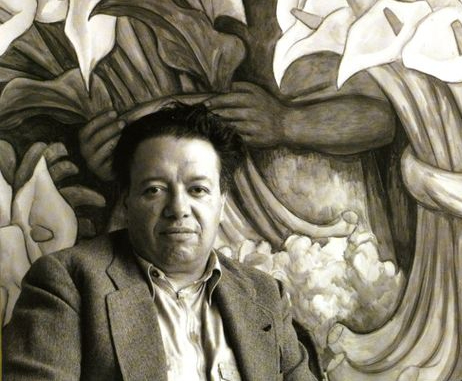
I love Diego’s work so I want you to know about him
Diego Rivera (1886–1957) was a prominent Mexican painter and muralist, best known for his large-scale murals that often depicted social and political themes. He was born in Guanajuato, Mexico, and showed an early talent for art. Rivera studied at the Academy of San Carlos in Mexico City and later traveled to Europe, where he was influenced by various artistic movements, including Cubism.
Rivera’s style evolved over time, but he became most famous for his mural work, which often celebrated Mexican culture, history, and revolution. He was deeply committed to the idea of art as a tool for social change and often portrayed the struggles of the working class and indigenous people in his murals.
One of his most famous works is the series of murals he painted at the National Palace in Mexico City, which depict Mexico’s history from ancient times to the Mexican Revolution. He also created murals in the United States, including at the Detroit Institute of Arts and the Rockefeller Center in New York City.
Rivera was a controversial figure in his lifetime due to his Marxist beliefs and his involvement in politics. He was a member of the Mexican Communist Party and had friendships with political leaders such as Leon Trotsky. His political views often influenced his art, and he used his murals as a means of promoting his socialist ideals.
Despite his controversies, Rivera’s talent and impact on the art world are widely recognized. His work continues to be celebrated for its powerful imagery, bold colors, and social commentary. He remains an important figure in the history of Mexican and Latin American art.
Diego Rivera is perhaps best known for his murals rather than individual paintings, but one of his most famous works is “Man at the Crossroads.” This mural was commissioned by the Rockefeller family in 1933 for the lobby of the RCA Building (now known as 30 Rockefeller Plaza) in New York City. However, the mural became controversial due to its inclusion of an image of Vladimir Lenin, which led to its destruction before completion.
After the mural’s destruction, Rivera recreated a similar but altered version of it in Mexico City’s Palacio de Bellas Artes. This version, titled “Man, Controller of the Universe,” is considered one of Rivera’s masterpieces and is widely regarded as one of the most significant examples of his work.
In addition to “Man at the Crossroads,” Rivera’s murals at the National Palace in Mexico City, which depict Mexican history from ancient times to the Mexican Revolution, are also among his most famous works. These murals are iconic symbols of Mexican culture and history and have contributed significantly to Rivera’s lasting legacy.
 SECOND Wind
Leave a comment